
Episode description: In this episode, Nat discusses their research on Rachel Carson and her efforts to raise awareness about the effects of pesticides on the environment and human health. They focus specifically on the use of the insecticide Dieldrin in the context of a behavioral epidemic, with Parkinson’s Disease being an observable symptom of its neurodegenerative effects as well as human carelessness in its application. This episode is an examination of societal cause and effect, and a reminder that the problems we create for ourselves do not go away just because we want them to.
Carson’s book, Silent Spring, was a key resource for this project, along with the National Park Service, a biography from the National Women’s History Museum, and an informational site from biographer Linda Lear.
For more details about the uses and behavior of Dieldrin, listeners can visit the following sites:
A chemical overview of the pesticide, its function, and health hazards.
From the National Library of Medicine; an analysis of the health risks of Dieldrin and other common pesticides.
An overview of Dieldrin’s function and persistence in the environment.
Basic description of the consequences of human exposure to Dieldrin.
A study on bioaccumulation and transmission of toxins between generations.
Further research on the impacts of Dieldrin on Parkinson’s Disease:
How Dieldrin increases toxicity in the brain and blocks neural pathways.
A case-control study of individuals with and without Parkinson’s Disease, studying their neural activity and previous pesticide exposure.
From the Federation of American Societies for Experimental Biology Journal; a study examining the effects of Dieldrin on dopamine production in the brain.
In a study of zebrafish, scientists found that mitochondrial function and the immune system were direct targets of Dieldrin poisoning.
An analysis of different types of environmental exposure to Dieldrin and its relationship to Parkinson’s Disease.
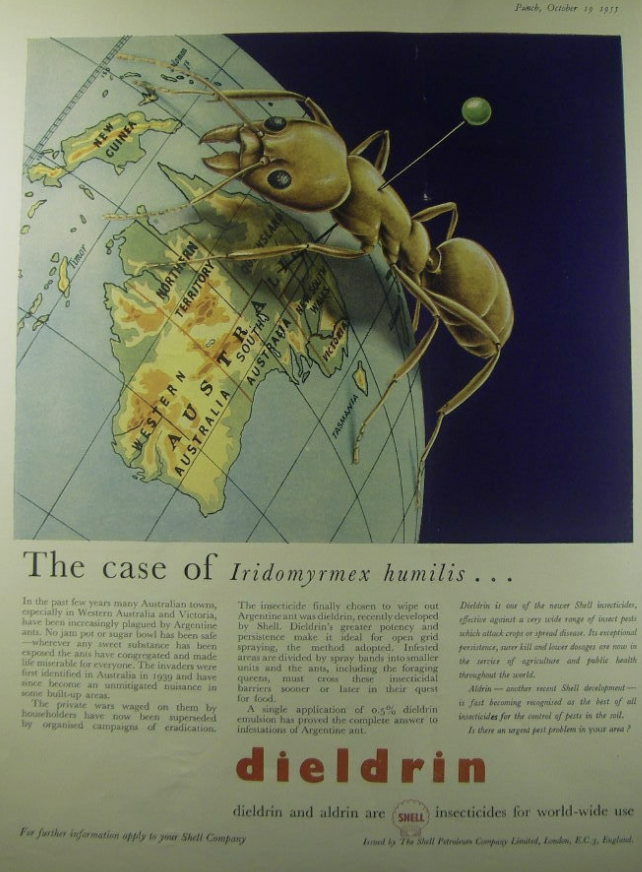
About the image: Image is an advertisement for the pesticide Dieldrin, sold by the Shell Petroleum Company as a means of controlling invasive species. The advertisement is presented as a successful case study targeting the Iridomyrmex humilis ant. This poster is old enough that I could only find a physical copy being resold online. This “report” contains no actual data and advocates for open grid spraying, one of the most harmful application methods with the most inadvertent contamination and one that Rachel Carson campaigned against.
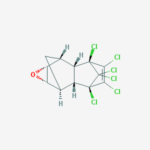
Cover image courtesy of the National Center for Biotechnology Information. PubChem Compound Database; CID=969491, https://pubchem.ncbi.nlm.nih.gov/compound/969491.
About the creator: Nat Gibbs is a senior at Wheaton College, majoring in Biology and minoring in Dance and Hispanic Studies. As a part of American Epidemics, their goal with this podcast is to explore the ways that epidemics impact the natural world and how the negative consequences of industrialization can adopt epidemic-like characteristics.
Episode Transcript: https://docs.google.com/document/d/1CKk9D6oF4BXNlcs5–3U4r3CZSjVN8vq2DN58h8V-2s/edit?usp=sharing